Most Thailand itineraries follow the same path: arrive Bangkok, do the temples, fly to Phuket, lie on beach, leave. It is a fine trip. But Thailand has a different personality in the mountains, a different pace in the northern cities, and beaches that bear no resemblance to the Phuket postcard if you know where to look.
Chiang Mai, the most livable city in Southeast Asia
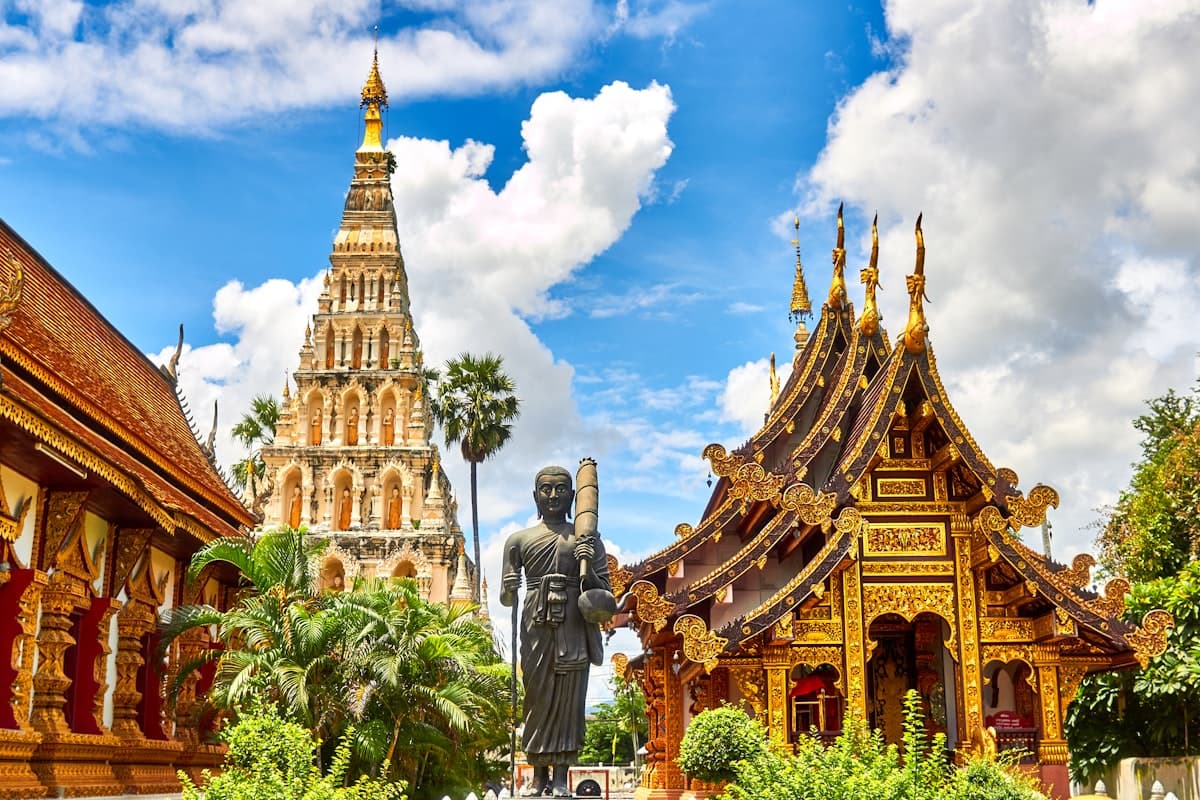
Thailand's second city sits in a valley in the northern highlands and operates at a human pace that Bangkok cannot match. The Old City is a moated square kilometer of temples, night markets, and cooking schools. Doi Suthep, the temple on the mountain above the city, is reached by a 306-step staircase flanked by naga balustrades and rewards the climb with views over the entire valley. The Sunday Night Market on Wualai Road is a kilometer of handmade crafts and street food, so arrive at 6 p.m. before it gets crowded and eat your way south.
The far north: Chiang Rai and the Golden Triangle
Three hours north of Chiang Mai by car, Chiang Rai is most famous for the White Temple, Wat Rong Khun, a contemporary artist's ongoing project that mixes Buddhist iconography with pop culture and political commentary. But the surrounding countryside, the hill tribe villages, and the point where Thailand, Myanmar, and Laos converge at the Mekong River are what stay with travelers.
Pai, the mountain town worth the winding road
Three hours from Chiang Mai by van on a road with 762 curves, Pai sits at 800 meters in a valley ringed by forested hills. It has bamboo bridges over the Pai River, hot springs a short ride from town, and a night market that runs on a more relaxed schedule than the rest of the country. If you are prone to carsickness, take motion-sickness medication before the road.
The quiet beaches: Koh Lanta, Koh Yao Noi, and Koh Kradan
Phuket and Koh Samui are large, well-developed, and heavily touristed. For something different: Koh Lanta is a long, thin island in the Andaman Sea with a fishing village on the east coast and long beaches on the west that clear out after October. Koh Yao Noi sits in Phang Nga Bay between Phuket and Krabi with almost no development, just Muslim fishing families, rubber plantations, and limestone karsts rising from the water in every direction. Koh Kradan, in the Trang archipelago, has the clearest water in Thailand and is accessible only by longtail.
The Thai food context travelers miss
Thai food in Thailand varies dramatically by region. Northern food like khao soi, the coconut curry noodle soup you will find in every Chiang Mai market, and sai ua sausage is nothing like the central Thai food that most international Thai restaurants serve. Southern food, with its Muslim influences, fish-heavy curries, and yellow turmeric rice, is different again. If you spend a week eating only pad thai and green curry, you have seen the cover and none of the chapters.